
Screw holes have been filled and joints faired using an epoxy, microballon and silica mix.
6 oz. fiberglass cloth then is spread over hull and smoothed out with a foam
roller. Fiberglassing is a time-consuming process that uses quite a bit of epoxy,
so we're limiting it to just the below-the-waterline part of the boat.
This will give more scuff resistance in case we ever want to beach the boat.
A major advantage of MDO is that everywhere else on the boat,
we'll simply apply 3 coats of epoxy to the MDO surface and then paint it.
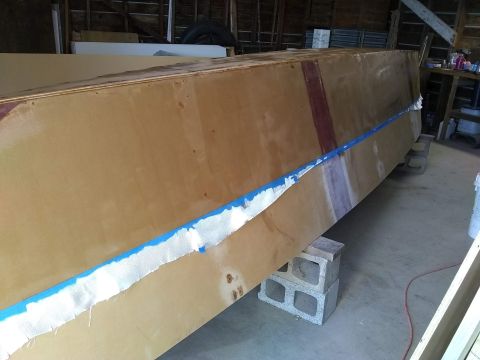
First coat of epoxy has been applied over cloth with a foam roller.
A total of 3 coats will go on, with each subsequent coat being applied when the
previous coat has just lost its tackiness, so all 3 coats go on the same day. This eliminates sanding between coats, which is a significant time-saver.
Immediately after each coat is applied, the stippled epoxy surface is evened out
using a dry paintbrush and long, horizontal strokes.
The next morning, the excess fiberglass cloth is cut along the top of the
tape line and tape is removed.
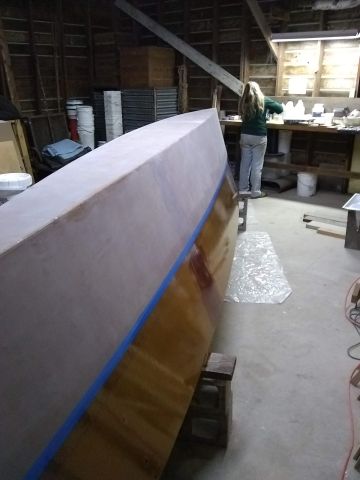
The fiberglassed portion of the hull is then sanded
smooth.
A new tape line is applied 1-1/2" above the fiberglass edge and
3 coats of epoxy are rolled on from the tape down to the sheer line.

When the epoxy cures, we wet surface with the sponge side of a squeegee.

While the hull is still wet, it gets sanded with 120 grit wet/dry sandpaper in
a palm sander. The squeegee sponge is used frequently during sanding to keep the
surface wet.
This technique smoothes the epoxy and eliminates the gloss and any amine blush, making a
paint-ready surface. It's also dust-free.

The surface is then re-wetted with the squeegee sponge.

And the squeegee is used to remove the wetted epoxy dust.

Hull #1 is now ready for bottom paint. It will then be turned over and
the decks and cabin installed. That will have to wait until next spring when
we return to Oregon.