 Rudder head mounted self steering system, showing wind vane, auxiliary rudder, pendulum oar carrier, pendulum oar and restraint line. |  When boat gets off course, wind vane cants over, causing pendulum oar to swing out, forcing auxiliary rudder to opposite side, thus steering boat back on course. |
 Showing wind vane canted to one side, pendulum swung out and auxiliary rudder forced to opposite side. |  Another angle showing pendulum oar swung to one side, forcing auxiliary rudder to opposite side. |
 Wind vane assembly |  Side view of wind vane assembly. |
 Close up of wind vane assembly. Donut-shaped disk is rotated to face vane in line with wind, then red clamp holds it in place. When boat gets off course, vane cants over, thus moving cords through pulleys which cause pendulum to swing to one side, in turn causing auxiliary rudder to swing to opposite side, steering boat back on course. |  Top view of RHM self steering system, showing cords through pulleys that transmit motion of wind vane to pendulum oar. |
Post-voyage comments (updated 10-14-2017):
On the shakedown trip from Santa Barbara to San Diego, our variation on the Alkema RMS (rudder head steering) self steering didn't work. When we got to San Diego and I had a chance to review the design I discovered that since Jan Alkema had used an upside down wind vane and ours was the more conventional rightside up design, I had crossed the control lines between the vane and the pendulum oar incorrectly. Once that was straightened out, it worked well and did nearly all the steering on the passage to French Polynesia.
Although it did almost all the steering, it often required considerable tinkering to get it dialed in with changes in wind direction or velocity. It just wasn't able to generate the corrective power it should have had. The reason was exactly as I'd predicted in the description above.
I eventually came up with a solution, but by the time we were in a position to carry it out the voyage was nearly over. In the event that anyone else wants to build a RMS self steering system for a boat with an angled rudder like on Minimus, I've included a couple photos below describing the fix. My only regret is that we never had the chance to make the fix and then sail with it, as the improvement would no doubt have been huge.
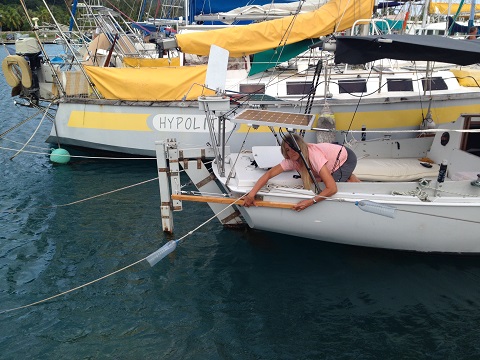 The fix for a RHM self steering system on a boat with an angled transom like that on Minimus is to mount a sturdy support in the position shown above. |
 (Top view) Once the support was in place, the oar carrier restraint line would go from the oar carrier directly to an anchor point at the aft end of the support. The restraint line would then be led forward to a quick release cleat on the stern. The same would be done on the other side of the transom. This modification would prevent the oar carrier from binding as it pivoted from side to side in response to corrections in the pendulum oar. |